For a time Ouédraogo worked with a farmer named Yacouba Sawadogo. Innovative and independent-minded, he wanted to stay on his farm with his three wives and 31 children. "From my grandfather's grandfather's grandfather, we were always here," he says. Sawadogo, too, laid cordons pierreux across his fields. But during the dry season he also hacked thousands of foot-deep holes in his fields—zaï, as they are called, a technique he had heard about from his parents. Sawadogo salted each pit with manure, which attracted termites. The termites digested the organic matter, making its nutrients more readily available to plants. Equally important, the insects dug channels in the soil. When the rains came, water trickled through the termite holes into the ground. In each hole Sawadogo planted trees. "Without trees, no soil," he says. The trees thrived in the looser, wetter soil in each zai. Stone by stone, hole by hole, Sawadogo turned 50 acres of wasteland into the biggest private forest for hundreds of miles.
Using the zaï, Sawadogo says, he became almost "the only farmer from here to Mali who had any millet." His neighbors, not surprisingly, noticed. Sawadogo formed a zaï association, which promotes the technique at an annual show in his family compound. Hundreds of farmers have come to watch him hack out zai with his hoe. The new techniques, simple and inexpensive, spread far and wide. The more people worked the soil, the richer it became. Higher rainfall was responsible for part of the regrowth (though it never returned to the level of the 1950s). But mostly it was due to millions of men and women intensively working the land.
Monday, August 31, 2009
Reclaiming Badlands
Last year while at the pediatrician's office on 7th Avenue I read an article in National Geographic called "Soil," and came across the story of an African farmer who, with the help of termites and dung, tenderized land that had become rock-hard and unfarmable, one hoe-hacked hole at a time. How unusual to read a story of one who doesn't run away from hard living conditions but stays and finds a way, cleverly allying with biological helpers, to bring new life to it.
Sigh. A version of this man (much smaller than life size) will always live in my brain now, hopefully hacking holes in there, so the blood gets around.


Saturday, August 29, 2009
Relics of a Belemnite Battlefield

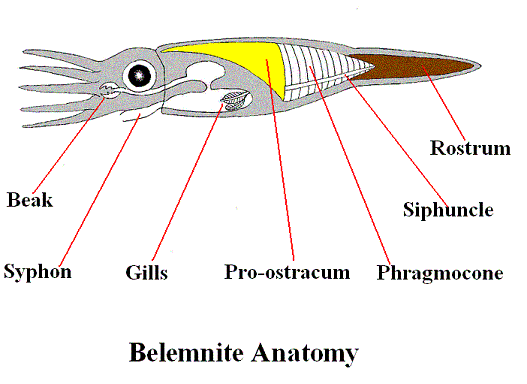
What I initially took for extraordinarily long, straight, cylindrical shark's teeth turned out to be fossilized squid bones, found among the pebbles and ancient shells in a stream bed in Colt's Neck, New Jersey. These relics of extinct cuttlefish posteriors, sometimes called squid pens or rostrums, served their extinct bearers as ballast for better swimming. From what I've read they didn't serve for much defense from larger predators since some creatures would swallow the squid whole and vomit the rostrums.
Made of calcite, the rostrums remain intact for eons. On occasion they are found in great abundance, and these spots are called belemnite battlefields, but it turns out they are most likely battlefields of love, where the adult squid die off en masse after spawning. Let's hope that was fun for them, the best thing ever.


Friday, August 28, 2009
Plastasia
Much talk of bricolage in various parts lately, perhaps presaging the discovery of a mass of slowly decomposing plastic the size of Texas in the North Pacific, reported in yesterday's NYT. An 8th continent, man-made, hormone disrupting, highly unstable, pulled in by the swirling currents of the North Pacific Gyre. And they haven't even checked the South Gyre yet. Oceanographer Miriam Goldstien, who writes the blog The Oyster's Garter, describes the situation, and waits for the other shoe to drop.
Thursday, August 27, 2009


Sunrise, NJ shore

One thing I learned in art school: it is unforgiveable to photograph sunsets. Maybe I can get away with a sunrise? Another thing I learned: Art is dead. I had some cinder-hearted teachers who taught their heart poisons in lieu of aesthetics. I didn't last long there. My best teacher was William Christenberry, the one who let us draw the elderly for life drawing.
Wednesday, August 26, 2009
Pone, Honey Twist, Venial Sin
I want to steal this 1940 pamphlet, 250 Delectable Desserts, published by the Culinary Arts Institute, "One of American's foremost organization devoted to the science of Better Cookery." I'm familiar with most of the categories here, only the Marlowe, some kind of whipped drink, raises questions, as well as the pone, which I've since learned is Virginia Algonquin for cornbread cakes baked in a fire. This little book has a recipe for Sweet Potato Pone, (unfortunately, not cooked in a fire), intriguing in its simplicity, made with 1 cup sugar, 1/2 cup butter, 2 cups grated uncooked sweet potatoes, 1/2 cup milk, 1/4 teaspoon salt, 1 teaspoon ginger, 1/8 teaspoon cinnamon, nutmeg, and the rind of 1 orange, combined and baked for 1 hour at 325 degrees. Seems somehow naked without eggs.
I also want to try the Honey Twist dough, 1 cup scalded milk, 1/4 cup shortening, 1/2 cup sugar, 1 t. salt, 2 cakes yeast, 1/4 cup lukewarm water, 2 eggs, beaten, 5-6 cups sifted flour. Pour mlk over shortening, sugar and salt. Crumble yeast into lukewarm water to soften. Cool milk to lukewarm, add yeast and eggs. Beat in four to make a soft dough, turn out on a floured board and knead until smooth. Place in a greased bowl, cover and let rise until doubled in bulk. When light, shape into a long roll 1 inch in diameter. Coil the roll into a greased cake pan beginning at the outside edge and covering the bottom. Brush with Honey 'topping. Let rise until doubled in bulk. Bake in moderately hot oven (375) 25 - 30 minutes. Makes 1 large twist.
Honey Topping: 1/4 butter, 2/3 cups confectioner's sugar, 1 egg white, 2 Tablespoons honey, warmed. Combine.
Also of interest on the accidental bookshelf: the 1946 edition of The Encyclopedia Americana. (It's not as Americana as you'd think.) Especially promising volumes seem to be Egusquiza to Falsetto, Sulphur to Tramways Aerial, Venice to Wassman Erich, and especially Trance to Venial Sin.
I also want to try the Honey Twist dough, 1 cup scalded milk, 1/4 cup shortening, 1/2 cup sugar, 1 t. salt, 2 cakes yeast, 1/4 cup lukewarm water, 2 eggs, beaten, 5-6 cups sifted flour. Pour mlk over shortening, sugar and salt. Crumble yeast into lukewarm water to soften. Cool milk to lukewarm, add yeast and eggs. Beat in four to make a soft dough, turn out on a floured board and knead until smooth. Place in a greased bowl, cover and let rise until doubled in bulk. When light, shape into a long roll 1 inch in diameter. Coil the roll into a greased cake pan beginning at the outside edge and covering the bottom. Brush with Honey 'topping. Let rise until doubled in bulk. Bake in moderately hot oven (375) 25 - 30 minutes. Makes 1 large twist.
Honey Topping: 1/4 butter, 2/3 cups confectioner's sugar, 1 egg white, 2 Tablespoons honey, warmed. Combine.
Also of interest on the accidental bookshelf: the 1946 edition of The Encyclopedia Americana. (It's not as Americana as you'd think.) Especially promising volumes seem to be Egusquiza to Falsetto, Sulphur to Tramways Aerial, Venice to Wassman Erich, and especially Trance to Venial Sin.
Tuesday, August 25, 2009
Accentor


The cicada's singing sounds of alien invasions as imagined by Hollywood, a pulsing martian's mind control ray. I wish I had a more sophisticated vocabulary of sonic principles to talk about how the note of buzzing radio static begun by one builds as a hidden chorus abandons itself to a gradual increase in pitch like emotional drunks on barstools before simmering down to a slowing arborial sizzle. The sounds seems to come from vibrating the abdomen, which seems very tricky to one who can't even hoola hoop.
Monday, August 24, 2009
Water Weave

This webwork boggles the mind, I've never stared at it long enough to find out if it would hypnotize me, but I should. These are Sebago shallows, the ones here at Ocean Grove were thick with pulverized jellyfish today - the clear kind. They hit the legs with force like a hail of rubber pellets, got caught between the toes. My daughter was unable to get them out of her hair, some are still in her mop, dessicated. They'll expand when it rains.
People here were allowed into the water up to their knees, but many went in deeper, keeping these very patient life guards on their toes.
Sunday, August 23, 2009
Ermine Moth-Ailanthus Webworm

At Ocean Grove. The last one I saw was at the Salt Marsh in Gerritsen Beach, Brooklyn, on the land bought for its preservation by Alfred Tredway White and Charles Pratt.
Maybe the Ermine Moth came to Ocean Grove for the Christmas Pageant that will be held on the beach here tomorrow. He has the exotic looks of one of the three kings, is he packing myrrh?
There's a book called Snowbound by John Greenleaf Whittier on the shelf of this rental house we're staying in with my husband's family. Apparently he's very well known in my parent's generation but scarcely heard of in mine, and among those who know of him I suspect he might be more famous for his cozy rhyming than for his abolitionism. And who knew, Ethan Allen is a poet, as well as patriot and furniture store! One of Whittier's poems, The Song of the Vermonters, 1779, was wrongly attributed to Allen for 60 years. Yes, I've been reading Wikipedia again, and you know what else? This poet was color blind and couldn't tell ripe from unripe strawberries, so it's probably a good thing he was too frail for farming.
The Funeral Tree of the Sokokis
In Maine I kept running into the word Sokokis, the only relic I've come across of the region's indigenous people. This poem by John Greenleaf Whittier about Sebago and the burial of Polan, the chief of the Sokokis, allows me to see the area and that place in history through the eyes of this 19th Century poet from this distant and knickknack obscured perspective of Ocean Grove, NJ. The land of granite boulders and "liquid plain" has given way to this beach town of Methodist victoriana.
Saturday, August 22, 2009
The Tarboxes

Raymond Cape is across the East part of Sebago Lake, called Jordan Bay, from my grandparent's house, this small camp turned residence which they bought in 1965. Near the tip of the cape there's a tiered outcrop of about 30 feet people jump from called Frye's leap. I think at one point I knew the story of Frye, I think the story goes that he leapt to escape hostile Indians.
Opening Sebago Lake Land (Herbert G. Jones, 1946) at random, I found this sad story on page 101, one I'd never heard before:
It was one of those distressing tragedies of early pioneer life that rarely if ever occur in these days. The Tarbox family consisting of mother, father, and four children, the eldest a girl of twelve, lived in a cabin on Raymond Cape. It had been a very severe winter, with storm following storm, cutting off all communications with their neighbors. Their provisions became nearly exhausted, and the father was compelled to set off on the long journey to get a bag of corn ground at the village mill. He reached the mill safely, and with the bag on his shoulders, started to retrace his steps. Meanwhile another storm came up, and within a short distance of his house, he sank down exhausted, unable to take another step.Interesting about compassion, it's faster than thought, it comes crashing over you before you know it, popping the heart like a water balloon and pooling around the feet.
He called for help, and his wife, anxiously awaiting his return, heard his cries and quickly left everything to go to his assistance. She soon found that she could make no headway in the deep drifts, so returned, and donning some of her husband's clothing, reached him while he was still alive. She couldn't move him, so taking off her coat, she covered him the best she could and set off herself in the direction of the nearest farmhouse for help. After a short struggle, her breath failed her and she sank down exhausted.
The children, left alone in the darkness, huddled around the fire, under the protection f the little girl of twelve, who kept blowing the horn throughout the night, trying to attract attention to their plight. But the storm closed them in for three days and three nights, before the alarmed neighbors could reach them. After a search they found the frozen bodies of the parents, and in the distress and excitement, the little tot of three had wandered off alone, and almost lost her life, before she was rescued and taken into the Hawthorne family as one of their own.
Wish I had time to read the rest of this book but leave today and can't take it with me. Maybe I'll come across it again or one of his other titles: I Discover Maine, Old Portland Town, Old Koussinoc, Maine Memories, Portland Ships are Good Ships, and Isles of Casco Bay.
Friday, August 21, 2009
Daddy Longlegs

Or Harvestmen, of the order Opiliones, named in 1833 by Swedish Naturalist Karl Sundevall. No one seems to know why he invoked the Latin for shepherd, Opilio. They've changed little in the last 400 million years. Just think, all that time without a name.
Not spiders, these arthropods have only one body part, making them walking cephalopds. But I understand the Greek for "head-feet" has been claimed by those swimming head-feet, the Octopi and their mullosk kin.
This unidentified member of Opiliones is one of many seen on the slopes of Rattlesnake Mountain in Raymond, Maine. If anyone has seen one in Brooklyn, I'd love to know. I never have.
Thursday, August 20, 2009
Ephemeroptera

"The mayfly belongs to group 1 taxa, or pollution–sensitive animals. This means if mayflies are in or around the water, the water should be of a good quality.[3]" (Wikipedia)
Fast clocks! As adults, they live from a few day to a few hours.


Wednesday, August 19, 2009
amphibious vehicle


From what I've read, the first oceans condensed from vapors of volcanic origin. They were not saline, the water cycle had not yet rinsed salts into them from terrestrial watersheds, so they made perfect germination pools for amphibians, those most tender creatures, no longer found in the now heavily salted seas, only in fresh water. But it seems to me all water is fresh, no manners at all. It just touches you wherever it wants, even from the inside.


Up here in Maine these places where rocks appear to push through asphalt are called heaves, a word I suspect finds more uses in winter in relation to the unabashed swelling of ice. As far as I know, ant hills are still called ant hills and crows are black as ever. I wonder what advantages their darkness gives them, if there's more to it than absorbing maximum warmth.
Tuesday, August 18, 2009
Around Sebago

A caterpillar with stripes similar to those of a snake I saw on the dock yesterday. In case you wondered, that's not my tongue it's found its way to.

A firefly? If so these Northern ones play up the stripes.

A pale green insect trying to get in the house, a slow moving tannin-dyed stream in the woods behind the lake. I suppose the color comes from leaves in decay.

No frogs around. One summer years ago there were buckets of them. I miss them. Victims of Chemlawn perhaps? Many yards around here suspiciously large and green.
I saw a Kingfisher fly over the lake.


Monday, August 17, 2009
You are not an image
Like others, I am haunted and plagued by images, reflections of others and self that bring dread and anguish, or mount a being on a peg from which it seems it will never escape. Today, from somewhere, a little medicine, a clearer view of the idea that we are not images, a little more explanation of what Rumi meant when he said "You are as you are, an indescribable message coming on the air."
When Jacob Boehme describes the fall of man in The Way to Christ his language intimates similar freedom. When he writes "The poor soul said "What shall I do that I may sprout forth again and come to my first life which I had in peace before I became an image," I recognize that constant but subliminal process by which my mind generates images of myself and others that I then start to honor as if that image were the thing, that same process that always incipiates the living death.
Hypnotized by images, we are driven to perfect our own reflection, to self-glorify, to perfectly adorn something which never existed in the first place. We are not images. Of people striving in this way, slaves of vanity, Boehme wrote "they run, but they are not made to run." We continually tailor the cloak of the mundane to perfectly fit a dressmaker's form that has no substance.
In Boehme, to fall is also to fall asleep, to take images for truth. Adam, "In his sleep, died to the angelic world (quality) and fell into the external fiat, and it now ocurred to the external image according to God's generation. Then his angel-form and might lay on the ground and fell in helplessness." So often we are helpless to the mental slackness by which we take images for truth, wherein the passive imagination continually mounts signs that lead us down roads toward identification and conflict, over and over again, where a trickster serpent mongers us out of our inheritance of peace and unity once again.
When Jacob Boehme describes the fall of man in The Way to Christ his language intimates similar freedom. When he writes "The poor soul said "What shall I do that I may sprout forth again and come to my first life which I had in peace before I became an image," I recognize that constant but subliminal process by which my mind generates images of myself and others that I then start to honor as if that image were the thing, that same process that always incipiates the living death.
Hypnotized by images, we are driven to perfect our own reflection, to self-glorify, to perfectly adorn something which never existed in the first place. We are not images. Of people striving in this way, slaves of vanity, Boehme wrote "they run, but they are not made to run." We continually tailor the cloak of the mundane to perfectly fit a dressmaker's form that has no substance.
In Boehme, to fall is also to fall asleep, to take images for truth. Adam, "In his sleep, died to the angelic world (quality) and fell into the external fiat, and it now ocurred to the external image according to God's generation. Then his angel-form and might lay on the ground and fell in helplessness." So often we are helpless to the mental slackness by which we take images for truth, wherein the passive imagination continually mounts signs that lead us down roads toward identification and conflict, over and over again, where a trickster serpent mongers us out of our inheritance of peace and unity once again.

Sunday, August 16, 2009



Saturday, August 15, 2009
Green Flare


The upside of a recent trip to Flushing, coming across the split casings of the Goldenrain Tree pods as a public art motif adorning the fence of the parking lot behind St. George's (note to self, there's a tree in that cemetery holding a very interesting dialogue with the Osage Orange in the Nethermead- must go back to investigate someday, and eat more soup. The tree looks like it has its own thesis on the afterlife.)
Goldenrain tree raining green a ways into the Queens Botanic Garden, past the weeping willow that weeps willows to end all weeping, planted across the walk from the orchard filled with crab apples and people who love inhabiting such a space. The new herb garden being added to the Brooklyn Botanic Garden will include an orchard, but don't expect to pick fruit from those trees, it will be forbidden, you can barely sit in the BBG much less eat there. Sometimes it seems like Brooklyn doesn't love Brooklyn so much, but that doesn't go for ATW, the garden's primary benefactor.
I'm excited Brooklyn will have an urban orchard, and do love the BBG even with its stringency. It's nuthin compared to the Red Hook Pool. And most likely, the fruit of the trees will be astringent, so no loss. What if Brooklyn had a public urban orchard? It's easy to imagine scenes that might unfold there, and the sort of ethics of usage that would evolve to be violated.
Providence RI was gorgeous today and hard to navigate, luminous unsupported domes, old brick, mullein, mysterious buildings, one vacant of its interior for 70 years (the old Masonic temple), another whose interior, viewed through the vacant spaces of massive windows, was stripped down to a grid of rusty beams that seemed to sing a coarse aria inside the brick shell.
Thursday, August 13, 2009
Coney as desert, with gull, underexposed umbel


The young gull's parent was somewhat near, it had dark grey wings. This was the biggest baby on the beach, with such beautiful patterns on its wings, I don't think it will get to keep those designs, though.
High points yesterday, learning that the original usage of the word mundane, being on the receiving end of Hafiz excerpts relating to moths (He is the lion of August). Also observing the tiny guillotine my daughter had made. I would fear a revolution, but I really like losing my head.
A line from Nicola Masciandaro's newest ghazal brought this passage from naturalist John Kiernan to mind:
A young man may say with regret that he has never traveled, but if he is twenty years old he has traveled well over 10,000,000,000 miles within our own little solar system, not to mention that far greater distance in galactial rotation at a speed of roughly 175 per second. And never a single mile of this amazing journey retraced!I'll be traveling to Maine today, via Rhode Island, hopefully right side up, and I'll miss Brooklyn and the way it accordions wherever you train your focus. I suppose that can happen elsewhere.
Tuesday, August 11, 2009
Hot and Hot
In a book I read recently, the author talks about taking iboga and visiting the sun to find angelic beings moving at incredibly high speeds, a picture that's lodged firmly in my imagination these days, taking a Blakian form.
Does heat cure hot? In my delirium, it seems that I need to cover up in black linen and wool to hide from heat, to drink hot water infused with cloves, to surround myself with creosote tarred logs, coal and things as dark and rich as mussel shells, asphalt, half burned rags. For color, some roses. Not the embalmer's roses that smell like death and hopelessness, but the ones that make a pyramid of citrus, spice and attar, those that hold you by the nose and dare you to walk away, the ones that make you cry because you have to go.
At Coney Island, clean, clear, calm, cold Atlantic water swimming with small sand-colored minnows you can only see because of their shadows, broken razor clams and purple black mussel shells rolling in the mica-flecked surf, some unopened. Everything edged with light. On the heads of the jetties, cormorants, birds that both fly and swim, swaggering between worlds, but while resting on the jagged rocks with their beaks angling towards the clouds, the slim black figures were the brush strokes of a long dead painter whose hand became a bird.
I don't think I'll stop thinking about hot things for a while, industrial grade pizza ovens, engines, asphalt, magma, Hasidim in full black coats and fur hats, chestnuts, cinnamon, the interiors of warehouses and of barns where the perfume of hay rides high in the heat, the aroma of tea, pepper, scorching silica, the crabs someone left to die in a hole, who can say why. Burning, expediting, purifying heat.
Does heat cure hot? In my delirium, it seems that I need to cover up in black linen and wool to hide from heat, to drink hot water infused with cloves, to surround myself with creosote tarred logs, coal and things as dark and rich as mussel shells, asphalt, half burned rags. For color, some roses. Not the embalmer's roses that smell like death and hopelessness, but the ones that make a pyramid of citrus, spice and attar, those that hold you by the nose and dare you to walk away, the ones that make you cry because you have to go.
At Coney Island, clean, clear, calm, cold Atlantic water swimming with small sand-colored minnows you can only see because of their shadows, broken razor clams and purple black mussel shells rolling in the mica-flecked surf, some unopened. Everything edged with light. On the heads of the jetties, cormorants, birds that both fly and swim, swaggering between worlds, but while resting on the jagged rocks with their beaks angling towards the clouds, the slim black figures were the brush strokes of a long dead painter whose hand became a bird.
I don't think I'll stop thinking about hot things for a while, industrial grade pizza ovens, engines, asphalt, magma, Hasidim in full black coats and fur hats, chestnuts, cinnamon, the interiors of warehouses and of barns where the perfume of hay rides high in the heat, the aroma of tea, pepper, scorching silica, the crabs someone left to die in a hole, who can say why. Burning, expediting, purifying heat.
Monday, August 10, 2009
Polyphemus

Polyphemus, the name of a cyclops, means famous. At first I thought this was the caterpillar of a Luna Moth, but those are spottier. This looks to be the last instar of the late summer brood of this variety of Giant Silk Moth (Saturniidae,) and it may winter in its chrysalis. I wish we'd kept it, but we took it to an Oak in Prospect Park, worried that it wouldn't last the hot dry sidewalk of Ft. Hamilton it was about to cross.
After the disappearance of the Parsley Worm our dill plant hosted last week, I don't want to take so many chances with caterpillars anymore, the are too precious. The worms have me wrapped around their fingers. Here's what this beauty will look like if she makes it.
Prize

Someone's object of fascination wedged deliberately into a bit of wooden fence at the Liberty Sunset Garden Center. It's easy to imagine this chunk of cellulose replacing Liberty's torch, glowing with lichen's cold fire. Modeling harmony, the graceful synchretism anyone hopes to find in this world, the close weave of algae and fungus is, as always, hard at work pressing the reset button, all the while dreaming who knows what dreams.
Subscribe to:
Posts (Atom)